
Why Brand Strategy Must Come Before Public Relations: A Guide for Commercial Real Estate Developers
PR cannot fix a brand strategy that was never defined. At least, not overnight.
Recently, a developer engaged Redhead Marketing & PR to build public awareness and support for a sizable commercial real estate development that promises to bring much-needed services to its surrounding community.
Redhead Marketing & PR is excited about the project because we believe in what it will offer. But there’s a challenge: We were brought in too late.
With a public announcement approaching, there is limited time to address foundational branding issues that could significantly influence how the community perceives the development.
The name could create confusion about where the project is located. And the messaging, brand story, and value proposition haven’t been formally defined.
These aren’t minor marketing details. They are strategic decisions that should inform every public-facing communication, from the website and community presentations to media interviews and press releases.
During our presentation to the development team, we explained why these elements matter, particularly in a community where new development can face significant opposition. We offered to accelerate the brand strategy process so we could establish greater clarity before the announcement.
The team acknowledged that this guidance would have been valuable earlier. But with the announcement approaching, they felt it was too late to revisit the name and that we needed to move directly into media relations.
No one understands the pressure of a deadline better than a public relations professional with decades of experience. But skipping brand strategy doesn’t eliminate the need for it. It simply means moving forward without the clarity and consistency that can make or break public perception.
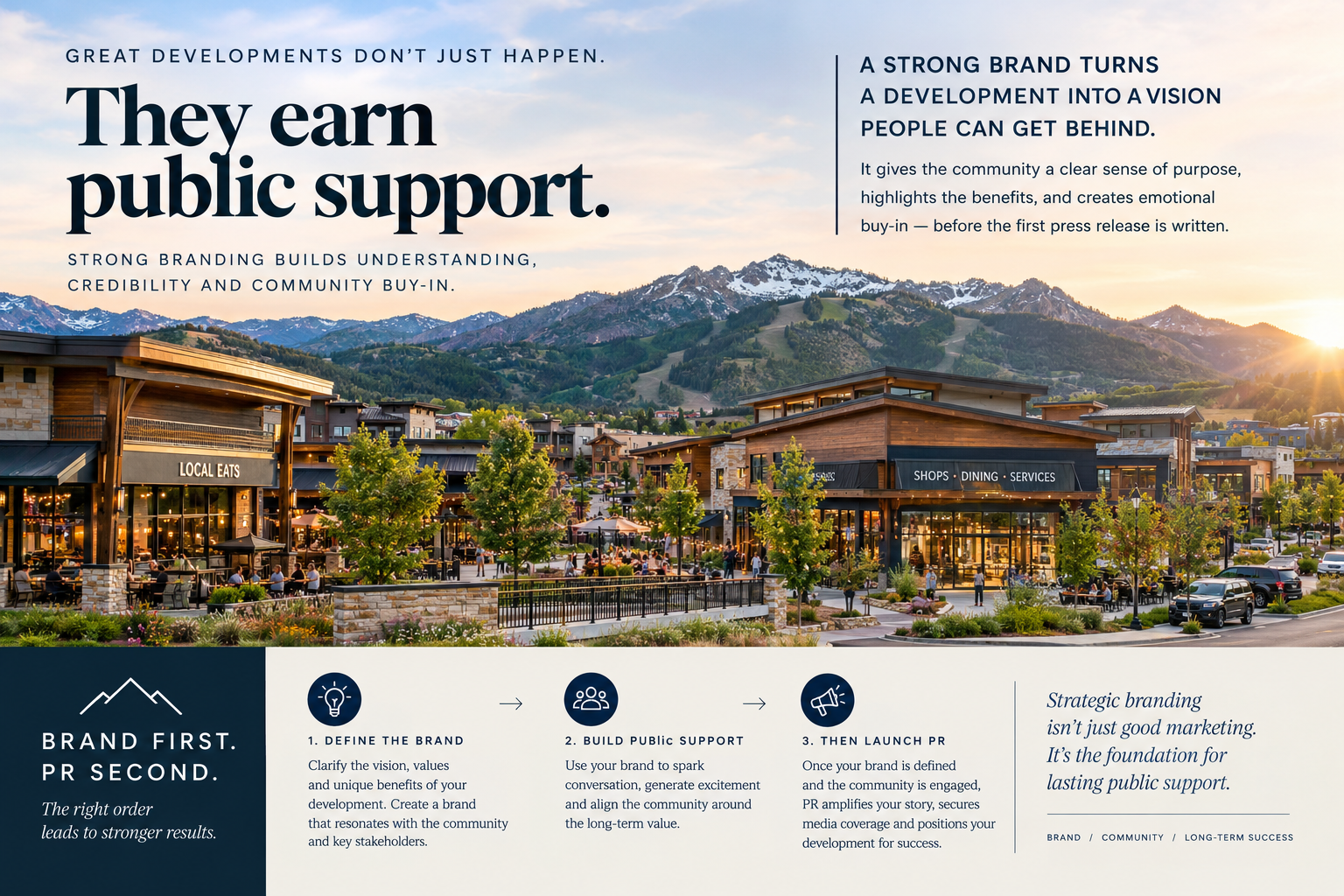
For developers investing significant time, money, and resources in projects that may face public scrutiny, the lesson is straightforward: Your brand strategy should inform your public relations strategy, not the other way around.
What Is Brand Strategy, and Why Does It Matter for Public Relations?
Brand strategy is the foundation that defines what an organization or development stands for, who it serves, what differentiates it, and how it should communicate its value.
For a commercial real estate development, brand strategy goes beyond choosing a name, designing a logo, or writing a tagline. It establishes the project’s identity, purpose, positioning, and messaging before those elements are introduced to the public.
Public relations translates that foundation into a communications strategy designed to build awareness, credibility, understanding, and, where appropriate, public support.
When brand strategy comes first, PR professionals have a clear framework for identifying compelling story angles, communicating benefits, anticipating concerns, and ensuring consistency across media coverage and stakeholder communications.
When that foundation is missing, even a well-executed PR campaign can struggle. Media coverage may generate awareness without explaining why the project matters. Messaging may change from one interview to the next. And a name or tagline that doesn’t reflect the development’s purpose can create confusion before the public has an opportunity to understand its potential benefits.
Brand strategy defines what you need to communicate. Public relations determines how, when, where, and to whom you communicate it.
7 Brand Strategy Steps to Complete Before Launching a PR Campaign
For commercial real estate developers (and virtually any other business), the following steps establish the strategic foundation needed for more effective public relations.
1. Define the Vision, Mission, and Purpose
Start by establishing why the development exists beyond its physical footprint.
What need does it address? What will it contribute to the surrounding community? What experience or opportunity will it create for residents, businesses, visitors, or future tenants?
A compelling vision describes the future the development hopes to help create. Its purpose explains why the project matters.
These answers must be specific enough to distinguish the development from other projects and meaningful enough to inform its public narrative.
For example, describing a development as a collection of retail, dining, office, and residential spaces explains what it contains. Explaining how those uses will meet unmet community needs and create a more connected place begins to explain why it matters.
The distinction is important when public support depends on demonstrating value beyond the developer’s financial objectives.
2. Identify the Target Audiences and Their Priorities
A development rarely has a single audience.
Potential stakeholders may include nearby residents, municipal officials, planning commissioners, local businesses, prospective tenants, community organizations, investors, and the media.
Each group may evaluate the project differently. Nearby residents may prioritize traffic, access, neighborhood character, or infrastructure. Local businesses may be interested in economic activity and customer access. Municipal leaders may focus on planning goals, public services, and long-term community outcomes.
Brand strategy should identify these audiences, what matters to them, what concerns they may have, and what information they need to understand the project’s value.
This research helps the PR team develop relevant messaging rather than relying on a generic announcement that assumes everyone will respond to the same benefits.
It also creates an opportunity to identify concerns early, when the development team may still have time to address them.
3. Establish the Value Proposition and Differentiators
A value proposition answers a fundamental question: Why should anyone care about this development?
Developers should be able to articulate the specific benefits the project will deliver, whom those benefits will serve, and how the development differs from existing alternatives or competing proposals.
A strong value proposition is not simply a list of amenities or an assertion that a project will be transformative. It connects specific project features to meaningful outcomes for defined audiences.
For example, if a development will introduce services that are currently difficult to access locally, that unmet need may be central to its value proposition. If it will create new public spaces or improve connectivity, those benefits should be clearly articulated and supported by project facts.
Credibility matters. Claims should reflect what the development can reasonably deliver, distinguish confirmed commitments from future aspirations, and avoid promising outcomes that cannot be substantiated.
This value proposition becomes the foundation for media pitches, executive talking points, website copy, community presentations, and responses to public concerns.
4. Evaluate the Name, Tagline, and Brand Identity
A development’s name is often the first piece of information the public encounters. It should help establish identity and, when appropriate, reinforce the project’s location, character, or purpose.
A name that suggests the wrong geographic location can create confusion. A tagline that doesn’t reflect the vision can establish expectations the project cannot meet—or fail to communicate what makes it distinctive.
Before finalizing these elements, developers should evaluate whether the name and tagline are:
- Clear: Do they communicate the right impression without creating unnecessary confusion?
- Relevant: Do they reflect the project’s purpose, positioning, and intended audience?
- Distinctive: Can the development be distinguished from other local places, projects, and brands?
- Credible: Do they accurately represent what is being built and what it will offer?
- Flexible: Will they remain relevant as the development evolves through future phases?
- Discoverable: Can people find the development online when searching for its name, location, services, or purpose?
The last point matters increasingly in AI-driven search. A distinctive name supported by consistent geographic references and clear descriptions can make it easier for search engines and AI systems to associate a project with the correct location and attributes.
Brand identity should be evaluated before an announcement makes a name or tagline more difficult, expensive, or politically sensitive to change.
5. Develop the Brand Story and Core Messaging
Once the vision, audiences, value proposition, and identity are established, translate them into a clear brand story.
The brand story explains what the development is, why it is being created, what need it addresses, and why its existence matters to the people it serves.
It should connect the developer’s vision to the audience’s interests without sounding like a sales pitch.
From that story, develop a messaging framework that includes:
- Core message: The central idea every communication should reinforce.
- Supporting messages: The principal benefits and differentiators that substantiate the core message.
- Proof points: Verified facts, research, project details, commitments, or other evidence supporting those claims.
- Audience-specific messages: Tailored explanations of relevance to residents, officials, businesses, tenants, and other stakeholders.
- Frequently asked questions: Clear answers to predictable questions about the project’s purpose, scope, location, timeline, impacts, and benefits.
- Spokesperson talking points: Consistent language that helps executives and project representatives communicate confidently.
This framework gives the PR team a reliable foundation for telling the story consistently across channels while allowing the emphasis to change depending on the audience and opportunity.
6. Assess Community Sentiment, Risks, and Potential Objections
For commercial real estate projects, particularly those in communities where growth and development are contentious, brand strategy should account for the environment in which the project will be introduced.
Developers should understand the local context, relevant planning discussions, community priorities, past development controversies, and likely areas of concern.
Research may include stakeholder interviews, public meeting records, local media coverage, community surveys, and conversations with people who understand the local landscape.
The objective is not to manufacture public enthusiasm or disguise legitimate concerns. It is to understand how the project may be perceived, identify questions that deserve credible answers, and determine which aspects of the development need clearer explanation.
This step informs both messaging and PR planning. It helps the team distinguish between misunderstandings that can be addressed through communication and substantive concerns that may require changes to the project, additional evidence, or direct engagement.
Public relations cannot substitute for responsible development decisions. It can, however, help ensure that the public has accurate information and a meaningful opportunity to understand the proposal.
7. Translate Brand Strategy Into a Public Relations Plan
Only after these foundational decisions have been addressed should the PR team build the campaign around them.
The public relations plan should define the communications objectives, priority audiences, story angles, channels, timing, spokespersons, and success metrics.
For a commercial real estate development, that may include:
- Developing an announcement that explains the project’s purpose and relevance, not just its size or investment.
- Identifying local and regional reporters whose audiences would benefit from the story.
- Preparing project leaders for media interviews and difficult questions.
- Creating a stakeholder outreach strategy that complements earned media.
- Developing consistent website copy, fact sheets, FAQs, and community presentation materials.
- Establishing a communications calendar aligned with planning milestones, construction phases, tenant announcements, and openings.
- Tracking outcomes such as message accuracy, quality of media coverage, stakeholder engagement, awareness, and changes in understanding or sentiment where measurable.
The objective is not simply to generate press coverage. It is to communicate a clear, credible story that supports the project’s broader business and community objectives.
What Happens When Developers Skip Brand Strategy?
When a developer moves directly into public relations without establishing its brand strategy, the consequences can extend well beyond an imperfect announcement.
Confusing positioning. An unclear name or tagline can create the wrong first impression or make the project difficult to distinguish from other developments.
Inconsistent messaging. Without a shared framework, executives, marketing teams, leasing representatives, and PR professionals may describe the project differently.
Missed storytelling opportunities. The campaign may focus on square footage, investment figures, and construction milestones instead of the community needs the development is designed to address.
Reactive communications. The team may spend valuable time correcting misunderstandings and responding to preventable questions rather than building awareness around a compelling narrative.
Reduced public confidence. If the project’s purpose and benefits are difficult to explain, audiences may struggle to understand its relevance or trust its promises.
Costly rework. Revisiting a name, tagline, website, or messaging framework after a public announcement can require additional time and expense.
None of these outcomes is inevitable. An experienced PR agency can help identify and mitigate weaknesses, even under a compressed timeline. But the agency’s ability to do so is constrained when foundational decisions are already considered final.
Can a PR Agency Fix Branding Problems After an Announcement?
Yes, a PR agency can help address branding and messaging problems after an announcement, but the available options depend on the nature of the issue, the project’s stage, and the flexibility of the development team.
Some problems can be addressed quickly by clarifying the value proposition, refining supporting messages, correcting geographic references, improving spokesperson preparation, or updating website descriptions and fact sheets.
Other issues, such as a fundamentally misleading name or a brand identity that conflicts with the project’s actual vision, may require broader stakeholder alignment and a more substantial strategic review.
The important distinction is between improving how a brand is communicated and correcting the strategic decisions that define it.
The former can sometimes happen quickly. The latter deserves sufficient time, research, and collaboration.
At Redhead Marketing & PR, we believe in addressing the underlying issue rather than relying on short-term communications tactics to compensate for it. That approach is especially important when a project has a long development horizon and its reputation will evolve over multiple phases.
When Should Commercial Real Estate Developers Hire a PR Agency?
The best time to engage a PR agency is during early project planning, when the developer still has the flexibility to refine its positioning, name, messaging, and stakeholder strategy.
Ideally, the agency should collaborate with the development teams before the public announcement is scheduled.
Early involvement allows PR professionals to contribute their understanding of media narratives, audience perceptions, reputational risks, and the questions journalists and community members are likely to ask.
A practical sequence looks like this:
- Define the development’s vision, purpose, and business objectives.
- Research audiences, local context, and stakeholder priorities.
- Establish the value proposition and brand positioning.
- Finalize the name, tagline, and identity.
- Develop the brand story and messaging framework.
- Assess reputational risks and prepare responses to likely concerns.
- Build and execute the public relations campaign.
- Evaluate results and refine communications as the project evolves.
This does not mean every branding detail must be perfect before any communication takes place. Project timelines are real, and announcements sometimes cannot wait.
It does mean that developers should recognize the trade-offs involved in skipping foundational work—and avoid treating PR as a last-minute solution to challenges that began much earlier.
Why Brand Strategy and Public Relations Work Best Together
Brand strategy and public relations are complementary disciplines, not interchangeable services.
Brand strategy establishes the project’s identity, purpose, positioning, and promise. Public relations communicates that promise through credible stories, media relationships, stakeholder engagement, and consistent messaging.
When the two work together from the beginning, the result is a more cohesive communications effort. The project has a clearer narrative, the PR team can identify stronger story angles, spokespeople can communicate with greater confidence, and audiences have a better opportunity to understand the project’s relevance.
For developments facing public scrutiny, this alignment is particularly valuable. Community support cannot be guaranteed through branding or PR alone, but a thoughtful strategy can make the project’s purpose easier to understand, its benefits easier to evaluate, and its communications more credible.
Redhead Marketing & PR: Brand Strategy and Strategic Public Relations in Utah
Redhead Marketing & PR is a Utah-based boutique public relations agency specializing in strategic media relations, brand messaging, reputation management, and communications strategy.
Led by experienced PR professionals, Redhead Marketing & PR helps organizations clarify their stories, identify what makes them newsworthy, and communicate their value to the audiences that matter.
For commercial real estate developers, this means looking beyond the announcement itself to understand the project’s positioning, community relevance, stakeholder landscape, and long-term reputation.
Our approach connects foundational brand strategy with the PR execution that follows. We work to ensure that names, narratives, value propositions, and supporting messages are aligned before they are amplified through media relations and other public-facing communications.
And when a project arrives late in the process, we work with the client to identify what can be improved now, what needs more substantial attention, and how to move forward as strategically as the timeline allows.In cases when a client hasn’t strategized and lacks the time to do so before the need to announce, we take on the project with the expectation and understanding that more in-depth attention to the brand will follow. This will give the project the strategic foundation it needs to progress as smoothly as possible from the municipal approval process to marketing itself to tenants.
The lesson for developers is simple: Don’t wait until the eleventh hour to engage your PR agency.
Before you tell the public what you’re building, establish what it stands for, why it matters, and how to communicate its value. Brand strategy first. Public relations second.
That is how more persuasive and impactful PR begins.
Interested in developing a brand strategy and a sound public relations approach for a commercial real estate project? Contact Park City, Utah-based. Redhead Marketing & PR to discuss how strategic positioning, clear messaging, and thoughtful media relations can help you communicate your project’s value. We have extensive experience partnering with real estate developments in Salt Lake City, Park City, and beyond.
Website: https://redheadmarketingpr.com/